Full-Stack Web App · PWA · Mobile App Design · Web Design
GrocerEase
The Challenge
Household grocery coordination is broken. Shared lists live in text threads, budgets are guessed, and the actual shopping trip has no structure. The challenge was to design a smart collaborative grocery app from scratch that replaced the dumb checklist with a genuinely useful household assistant, while keeping the experience light enough that it never felt like more work than the problem it solved.
The Approach
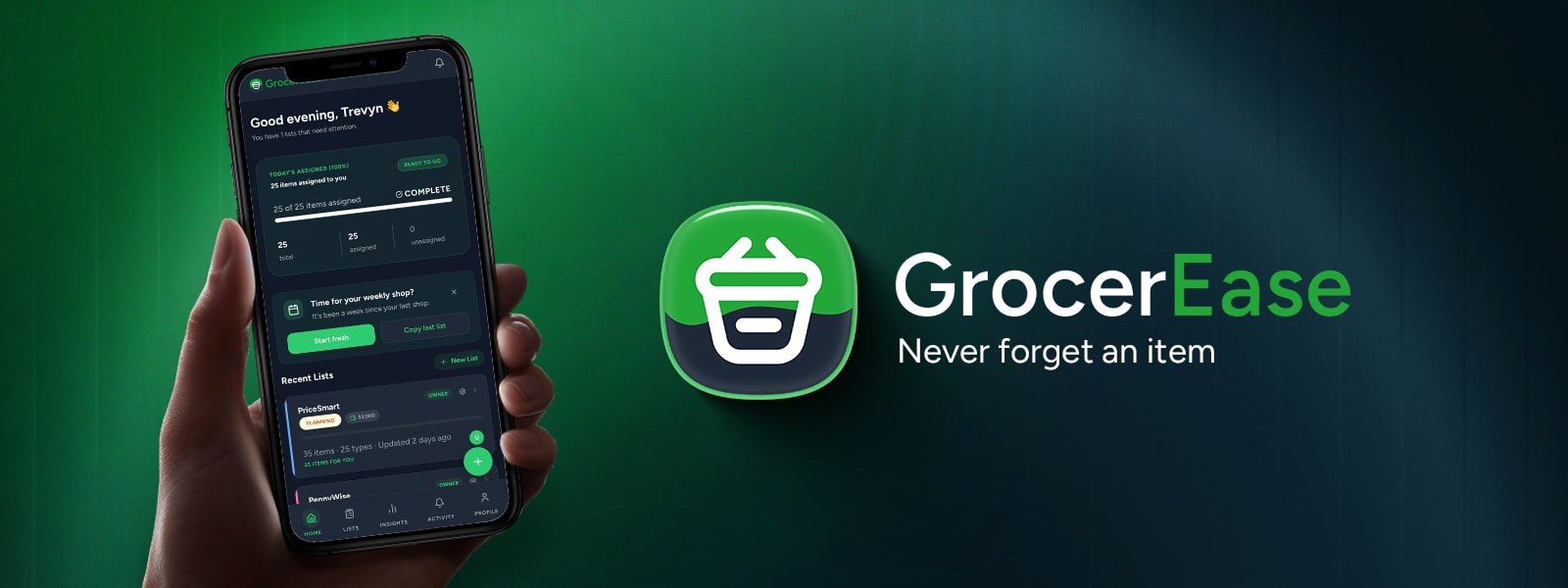
I designed GrocerEase around three distinct interaction modes, each with its own flow and visual rhythm: list building, active shopping, and post-trip reflection. List building centres on a drag-and-drop item architecture with category grouping, assignment, urgency flags, and inline budget tracking. Shopping Mode shifts the UI into a focused, checklist-driven state with a Pre-Departure Checkpoint modal that surfaces health warnings before the user leaves the house. Trip Recap closes the loop with an animated badge reveal, turning a mundane task into a moment worth finishing. The component architecture enforces clear separation between modal types, using a bottom sheet on mobile and a centred dialog on desktop throughout, with a gamification layer (8 badges, streak tracking, and a Usuals carousel) woven into the experience rather than bolted on. A Pro tier introduces an analytics suite built with Recharts, including a dual-view Price History chart that defaults to a table on mobile for touch usability. The visual system runs on CSS custom properties for full dark mode fidelity, with Motion used for spring-animated reveals and micro-interactions that reward task completion without adding noise.
The Outcome
GrocerEase shipped to production at getgrocerease.com as a fully functional, monetisation-ready MVP. The three-mode UX structure, gamification system, and Pro analytics suite are live and operational, with the end-to-end product loop from onboarding through to paid conversion validated in a real production environment.
Next Project